Travis,
Consider this an open letter. In a few days you very well may be elected to the Montana Public Service Commission, and in that capacity you will have to take the following Oath:
"I do solemnly swear (or affirm) that I will support, protect and defend the constitution of the United States, and the constitution of the state of Montana, and that I will discharge the duties of my office with fidelity (so help me God)."
As an individual I am excited to see someone as young as you, and with a strong hunger for truly understanding the issues of the day, get involved in public service. But as an elected official, and what the Oath speaks to (especially the part about fidelity), is that you have an obligation to be honest and to not purposefully and maliciously distort the truth to fit your political needs.
So, please stop. Your editorial yesterday in the Great Falls Tribune is a pathetic work of fiction. Typically, I would dismiss it as just some person picking numbers to fit political needs. But you know better. You went to Harvard. You know as well as I do, that NorthWestern Energy is not going to pay the "average price per MWh" from it's RFI, and that they have selected a group of finalist with expected cost of around $65 MWh. Not the $80.14 as you allude to. I know that you know this because you quoted the relevant PSC docket in your TV ad.
You also know, that given the "historical levelized price of Mid-C" of $54 per MWh, that locking in $65 per MWh for a small portion (5%) might be a good deal and an effective way to minimize some of the high price risk of Mid-C.
If you don't like mandates and that is your beef with the RPS, ok. But than suggest some progressive ways that regulators can help to influence energy procurement decisions in Montana, instead of just massaging numbers and the narrative to meet your political needs. If you need some suggestions, or want to better understand these issues, please send me an email mtroscoe [at] gmail.com.
Fidelity Travis, fidelity.
Update: Travis' Response 11/1/2010
Dear Roscoe --
I've said it before and, despite your PSC coverage, I will say it again: Thank you for starting an energy blog. I can tell from reading the posts which do not concern me that we probably have a number of mutual sympathies, our differences notwithstanding.
First things first, I consider my Tribune piece considerably more factual than Mr. Brouwer's, with realization that we are both speculating about the possible future prices of electric power. The logic of my argument hinges on my use of an average deduced from a list of renewable proposals, as you note. I do not consider an average number unfair. Considering that the lowest-cost renewable proposals are also likely to be the largest facilities with the largest footprint -- just the type to be ripe for a NIMBY kibosh these days -- I consider it prudent to weight toward an average. Moreover, the number Mr. Brouwer has chosen as the stand-in for coal-fired generation is on the high end of the cost spectrum.
If you object to $80, how about we just call it fair at $71 per MWH, like the 80 MW-sized facility approved by Idaho's PUC? That is the likelier direction of wind development, and still significantly higher than the levelized Mid-C price or even a multicycle natural gas facility, supposing the glut of gas continues because of shale finds. Of course even that price does not accurately represent the additional value (or, in wind's case, lack of value) deriving from sales of excess electricity on the market. Wind is notoriously difficult to sell, and this diminishes its value in a way which is often not quantified.
Anyways, I think you misconstrue my point. I'm not against wind development. There clearly are projects which are feasible. Judith Gap appears to be one of these--and it would have been developed regardless of a mandate (a point of fact with which those mining it for figures do not grapple).
My problem is with the RPS. I have yet to hear any explanation of why a mandate makes sense, or why expanding the mandate would be a good deal for consumers. Instead, I hear the fallacy parroted over and over that wind is simultaneously a good deal economically, but that government needs to muscle you into this "good deal." When challenged on this apparent contradiction, the only response is something a la Mark Jacobson's vague prognostication that there are "market barriers that prevent renewable energy from competing on a fair basis," which is not followed by an attempt to explain any of them. I am merely looking for a credible and detailed explanation of what these barriers between a utility and low-cost electricity would be.
Nor am I denying that wind development here has something to do with West Coast mandates, with the federal renewable production tax credit, with utilities' own anticipation of Congressional and regulatory reform. But what man does can be undone. Tomorrow, California voters will be asked whether they will suspend the Calif. Renewable Portfolio Standard. The production tax credit is also scheduled to expire next year, unless Congress renews it. (On behalf of economic development in the Rocky Mountain states, I implore California voters to take the advice of the Sierra Club and continue to subject themselves to this onerous mandate.) The question is: Will the bottom fall out of renewable development?
I suppose I just don’t see why Montana — with a consumer base about 1/50th the size of California — should have to take the plunge when its commodities/resources competitors (North Dakota, Wyoming) are not. Especially when I'm a candidate for an office whose only historical purpose is to keep costs as low as possible without bankrupting the utility or stifling investment, I find it pretty rich that I'd be asked to endorse a mandate -- the sole purpose of which is to compel wind production even if it is not price-competitive. The fact that Wyoming has more MWs of wind development today even without a WY mandate should be evidence enough that an escalated RPS in Montana would be a needless act.
Anyways, I'd love to meet up for dinner or something in that netherworld of time before I take office -- should, of course, I have the good fortune to be elected by the people of PSC District #1. In spite of my politics, a good deal of my friends are liberals and I'm sure we will get along.
Feel free to reprint the above on your blog.
Sincerely,
Travis Kavulla
Showing posts with label RPS. Show all posts
Showing posts with label RPS. Show all posts
Thursday, October 28, 2010


Sunday, October 24, 2010
The Future Cost of Electricity in Montana
Travis Kavulla has tweaked his arguments against the Montana RPS, and is acknowledging that the RPS has not increased rates for Montana to date, but is poised to do so in the near future. And in doing so, Travis has highlighted an important question, what will different forms of energy cost in the future?
One of the undisputed benefits of wind, or renewables, is that they allow utilities and customers to lock in rates at construction. Unlike fossil fuels, the price of wind does not depend on the variable cost of fossil fuels.
Travis Kavulla has claimed that the next generation of wind will cost $69 per MWh, which is NorthWestern Energy's avoided cost rate. I think that the avoided cost rate is actually a poor proxy for future wind costs, and that actual rates will be around $55 per MWh (depending mostly on the cost of integration), but these are small details.
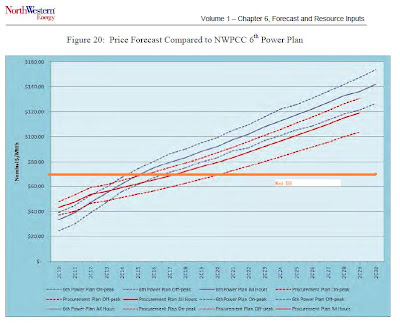
The real point is that even at $69 per MWh, Montana consumers have a fairly good deal on their hands. Why? Energy prices are projected to increase. Below is a figure from NorthWestern Energy 2009 Resource Procurement Plan, Page 119 of Chapter 6, that shows several projections for future market prices of electricity. I have added an orange line to show where the $69 per MWh wind cost falls out. The obvious implication is that wind offers Montanan's the opportunity to lock in low and reasonable prices for a portion of the electricity we consume (not necessarily all of it), but enough to hedge against future predicted price increases and volatility.
One of the undisputed benefits of wind, or renewables, is that they allow utilities and customers to lock in rates at construction. Unlike fossil fuels, the price of wind does not depend on the variable cost of fossil fuels.
Travis Kavulla has claimed that the next generation of wind will cost $69 per MWh, which is NorthWestern Energy's avoided cost rate. I think that the avoided cost rate is actually a poor proxy for future wind costs, and that actual rates will be around $55 per MWh (depending mostly on the cost of integration), but these are small details.
The real point is that even at $69 per MWh, Montana consumers have a fairly good deal on their hands. Why? Energy prices are projected to increase. Below is a figure from NorthWestern Energy 2009 Resource Procurement Plan, Page 119 of Chapter 6, that shows several projections for future market prices of electricity. I have added an orange line to show where the $69 per MWh wind cost falls out. The obvious implication is that wind offers Montanan's the opportunity to lock in low and reasonable prices for a portion of the electricity we consume (not necessarily all of it), but enough to hedge against future predicted price increases and volatility.

Friday, October 22, 2010
Excellent Commentary on Montana Energy Prices
Ben Brouwer with AERO, hits the nail on the head in his op-ed that ran in the Missoulian yesterday, on the relative cost of energy for Montanans. As I have already talked about these costs here before, I wanted to take the analysis one step further and calculate the welfare savings to Montanans.
Basically, how much has Judith Gap and the MT RPS saved Montana Consumers. For simplicity sake, I will just compare the plant to Colstrip 4.
450,000 (Judith Gaps approximate annual generation) * 18 ($/MWh savings for Judith Gap) * 4.5 (length of time Judith Gap has been online, years) = $36,450,000
That's right, the Montana RPS has saved Montana Consumers approximately $36 million.
It would of course be more accurate to compare the price of Judith Gap to the hourly market prices that NorthWestern Energy has paid, but these prices are not nearly as constant as Colstrip 4 and require more time than I have to determine.
Basically, how much has Judith Gap and the MT RPS saved Montana Consumers. For simplicity sake, I will just compare the plant to Colstrip 4.
450,000 (Judith Gaps approximate annual generation) * 18 ($/MWh savings for Judith Gap) * 4.5 (length of time Judith Gap has been online, years) = $36,450,000
That's right, the Montana RPS has saved Montana Consumers approximately $36 million.
It would of course be more accurate to compare the price of Judith Gap to the hourly market prices that NorthWestern Energy has paid, but these prices are not nearly as constant as Colstrip 4 and require more time than I have to determine.
Sunday, October 10, 2010
Travis Kavulla's Attack Ad: false (Part II)
The blog got a lot of activity after the previous post about Travis Kavualla's attack ad, and i suspect that Travis' google alert has directed him to the site. So, now that i have your attention, let's get to the real meat of the problem with Travis' ad.
Your second claim, "And he voted to force your power company to spend double the market price to buy renewable energy or credits". First, I doubt this would survive a complaint to the Commission of Political Practices without even a date to reference Don Ryan's purported vote or the bill number. But for the purpose of argument, and please correct me if I am wrong, the reference was probably to the MT Renewable Portfolio standard (RPS) which mandates that regulated utilities (NorthWestern Energy, MDU, and apparently the City of Great Falls) purchase a portion of energy from renewable energy products.
Ok, so does the RPS standard require utilities to buy energy at double the market price? Travis offers two links, which i have pulled and posted for everyone's convince, that are apparently related to his claim.
1. http://ferc.gov/market-oversight/mkt-electric/northwest.asp (This link was slightly modified to work), referred to as "link 1"
2. http://www.psc.mt.gov/eDocs/eDocuments/pdfFiles/D2010-7-77IN10080634144TA.pdf , referred to as "link 2"
As Travis did not provide page references or any analysis, we are left to wade through the data to provide the substance for his claim (Travis consider this an open offer to provide your analysis).
First, Travis's link to the MT PSC Docket (Link 2) is about rates for qualifying facilities, which is the rate approved by the MT PSC for such faciliteis (wind, biomass, etc.) to be paid if they elect to sell power to either of the state's regulated utilities. Oddly, these facilities are not part of the MT RPS standard, so I am not sure how their rates (at least on face) relate to the rate that NorthWestern Energy or MDU pays for energy from RPS facilities.
Also, to the extent the rates are related, they are forward projections and do not reflect the actual rates NorthWestern Energy has paid for RPS energy, and as Travis' claim was past tense, I am going to limit my analysis to that world.
Thanks to Commissioner Toole's op-ed the actual rate that NorthWestern Energy pays is known, and it is .38 cents. With that, we can use link 1 to compare that to historical market rates, as described by FERC, to the price that NorthWestern Energy has paid for it's RPS Energy.
See chart.

Now, i read that chart to show an average rate of about $40 per MWh over the last year, with some interesting spikes and valleys. For arguments sake, lets actually call it an average of $30 per MWh, which makes it cheaper than wind. We are also looking at a selective period of low prices. See the chart in the upper right for market prices during periods of greater economic demand (they average above $60 per MWh during 2007-2008).
My call from Travis' information? That the MT RPS standard has resulted in NorthWestern Energy paying about an equal amount for energy from renewable as power from the market. I actually think the Montana RPS has saved Montana Consumers money, but I will not ask for you to believe an anyomoys blogger until I take the time to throughly prove my case.
Your second claim, "And he voted to force your power company to spend double the market price to buy renewable energy or credits". First, I doubt this would survive a complaint to the Commission of Political Practices without even a date to reference Don Ryan's purported vote or the bill number. But for the purpose of argument, and please correct me if I am wrong, the reference was probably to the MT Renewable Portfolio standard (RPS) which mandates that regulated utilities (NorthWestern Energy, MDU, and apparently the City of Great Falls) purchase a portion of energy from renewable energy products.
Ok, so does the RPS standard require utilities to buy energy at double the market price? Travis offers two links, which i have pulled and posted for everyone's convince, that are apparently related to his claim.
1. http://ferc.gov/market-oversight/mkt-electric/northwest.asp (This link was slightly modified to work), referred to as "link 1"
2. http://www.psc.mt.gov/eDocs/eDocuments/pdfFiles/D2010-7-77IN10080634144TA.pdf , referred to as "link 2"
As Travis did not provide page references or any analysis, we are left to wade through the data to provide the substance for his claim (Travis consider this an open offer to provide your analysis).
First, Travis's link to the MT PSC Docket (Link 2) is about rates for qualifying facilities, which is the rate approved by the MT PSC for such faciliteis (wind, biomass, etc.) to be paid if they elect to sell power to either of the state's regulated utilities. Oddly, these facilities are not part of the MT RPS standard, so I am not sure how their rates (at least on face) relate to the rate that NorthWestern Energy or MDU pays for energy from RPS facilities.
Also, to the extent the rates are related, they are forward projections and do not reflect the actual rates NorthWestern Energy has paid for RPS energy, and as Travis' claim was past tense, I am going to limit my analysis to that world.
Thanks to Commissioner Toole's op-ed the actual rate that NorthWestern Energy pays is known, and it is .38 cents. With that, we can use link 1 to compare that to historical market rates, as described by FERC, to the price that NorthWestern Energy has paid for it's RPS Energy.
See chart.

Now, i read that chart to show an average rate of about $40 per MWh over the last year, with some interesting spikes and valleys. For arguments sake, lets actually call it an average of $30 per MWh, which makes it cheaper than wind. We are also looking at a selective period of low prices. See the chart in the upper right for market prices during periods of greater economic demand (they average above $60 per MWh during 2007-2008).
My call from Travis' information? That the MT RPS standard has resulted in NorthWestern Energy paying about an equal amount for energy from renewable as power from the market. I actually think the Montana RPS has saved Montana Consumers money, but I will not ask for you to believe an anyomoys blogger until I take the time to throughly prove my case.
Subscribe to:
Posts (Atom)

 Posts
Posts

